
You're evaluating a second-source sea salt supplier.
The reasons are familiar. Pricing on the incumbent contract moved, availability got unreliable, and lead times started slipping. Procurement was tasked with finding cost savings, or the current supplier simply stopped hitting spec consistently enough to trust.
For many manufacturers, qualifying a second source is about reducing operational risk before availability becomes a crisis. Most teams just want a fallback ready.
On paper, the replacement candidate looks close enough:
"Fine sea salt. 0.2 to 0.8 mm."
Pricing works. Documentation looks acceptable, and a sample gets approved.
Then production scales up and the line tells you something the spec sheet didn't.
You start seeing uneven seasoning distribution, excessive dusting, feeder inconsistency, dissolution behavior drifting from the incumbent, visible crystal variation in finished product, or interruptions that weren't happening before. Suddenly the "same" ingredient is behaving differently enough to cause production consequences.
Reformulation conversations start. A retailer ship date slips while everyone tries to figure out why.
The issue is whether the supplier can consistently match the particle size distribution your application was built around. The label "fine" or "coarse" barely tells you anything.
Procurement may see similar ranges and similar pricing. R&D sees the process variables hiding inside the distribution curve. A qualification that ignores either lens is how a bad supplier gets approved.
This guide walks through how experienced teams evaluate that match before committing to a new supplier.
What "particle size" actually means on a spec sheet
A grain size specification does more work than it looks like.
The nominal range tells you the outer bounds. The constraints underneath tell you how the material is actually distributed within those bounds. That distribution is what drives behavior on the line.

Grain size is the difference between two salts that read identically on a label — the distribution within the range is what production actually feels.
Take a typical Fine Salt specification:
- Range: 0.2 to 0.8 mm
- Max 5% over 0.8 mm
- Min 80% passing a 0.71 mm sieve
- Max 5% under 0.2 mm
"0.2 to 0.8 mm" alone is incomplete. Real-world process behavior lives inside those additional constraints.
The upper bound controls oversized particles. When that limit drifts, manufacturers start seeing inconsistent dissolution, visible specking, feeder interruptions, uneven texture, or even line clogs in more sensitive applications.
The midpoint (minimum 80% passing a 0.71 mm sieve) defines the primary working population. This is where most of the salt actually sits, and where blending uniformity, dosing consistency, coating performance, and process repeatability are determined. Two salts can share the same nominal range while behaving very differently here.
The lower bound controls fines. Excess fines contribute to dusting, segregation in dry blends, inconsistent flow, dosing variance, and handling loss across the line.
Three numbers describing one distribution.
A supplier who measures and publishes constraints at all three points is demonstrating process control. A supplier whose spec sheet stops at "0.2 to 0.8 mm" is telling you something about their data, whether they mean to or not.
Matching granulation to the application
TEKPAK supplies three Dead Sea sea salt granulations. Crystal size is the surface difference. Underneath, granulation drives flow behavior, blending consistency, dissolution, ingredient declarations, and how the material behaves in production.
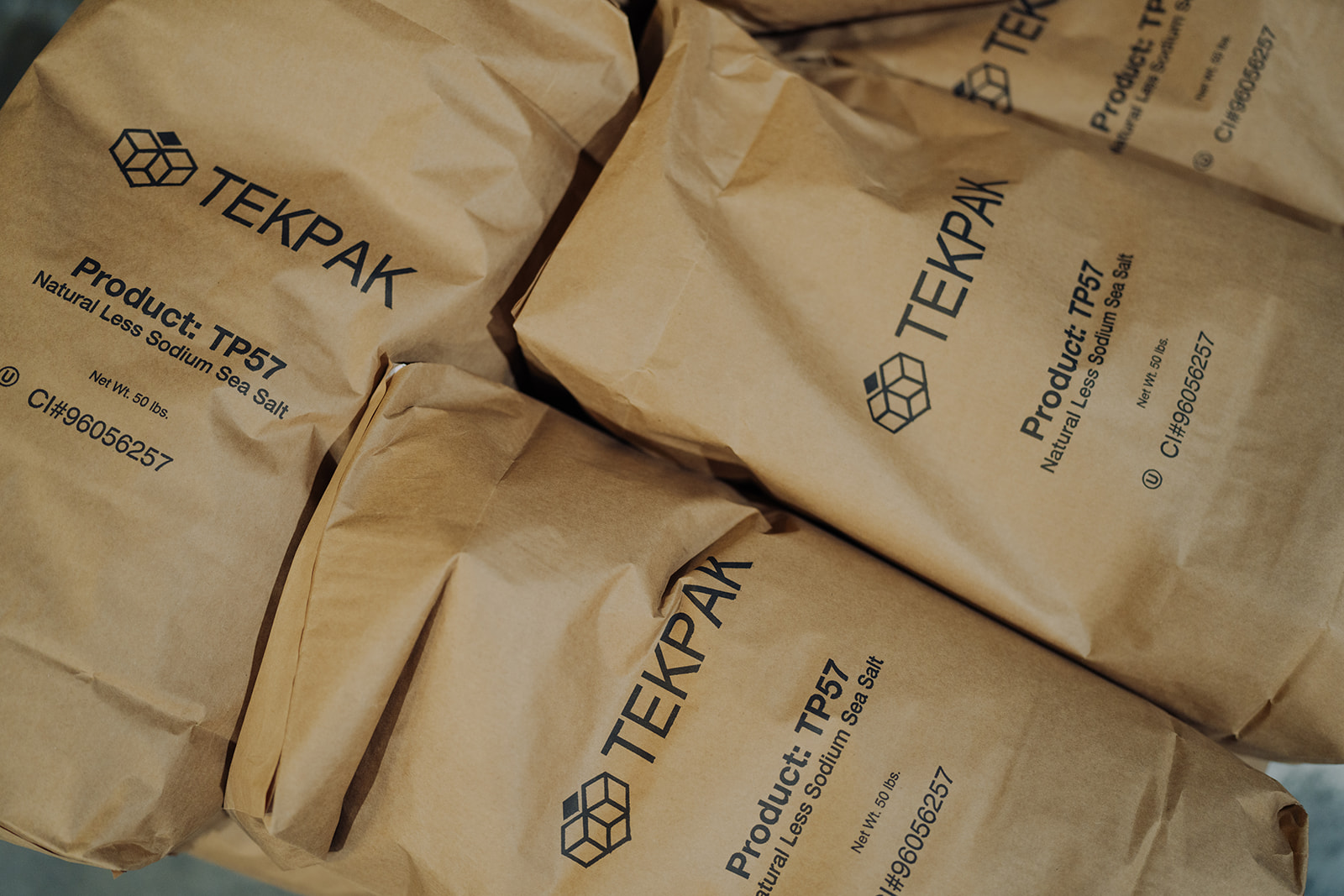
Finished sea salt staged at TEKPAK's Marion, AL facility — the granulation inside each bag is matched to the application it's built for.
Extra Fine Sea Salt
Extra Fine ranges from 0.2 to 0.6 mm, with a minimum 90% of particles falling within range. It contains sodium ferrocyanide (E535/YPS) anti-caking agent at 5 to 13 ppm and meets FCC-grade specifications with a minimum NaCl purity of 99.5%.
This granulation is typically used in applications where dispersion consistency matters more than visible crystal structure:
- seasoning blends
- snack coatings
- cure systems
- instant soup mixes
- dough applications
- reduced sodium blends
- powder systems requiring tight dispersion
Because the distribution is tighter, Extra Fine tends to incorporate more evenly into powder systems and resist segregation during handling and transport. It also supports more consistent volumetric dosing and faster dissolution than larger crystal formats.
TEKPAK uses Extra Fine when blending sea salt with potassium chloride for reduced sodium products. Tighter distributions help reduce segregation between sea salt and KCl in the finished blend. That matters when the ingredients behave differently in processing and storage.
Fine Sea Salt
Fine Sea Salt ranges from 0.2 to 0.8 mm and includes additional distribution constraints:
- maximum 5% over 0.8 mm
- minimum 80% passing a 0.71 mm sieve
- maximum 5% under 0.2 mm
Like Extra Fine, it contains E535 anti-caking agent at 5 to 13 ppm and meets FCC-grade specifications.
This tends to be the most versatile manufacturing granulation in the lineup. It's commonly used in:
- breadings
- coatings
- prepared foods
- soups and broths
- brines
- table salt-style retail formats
- general food manufacturing
Fine balances flowability, dissolution behavior, and process flexibility across a broad range of applications. When a production line has been tuned around a controlled particle profile, even modest shifts in fines or oversized particles can change how the material behaves in feeders, coaters, and dispensing systems.
Coarse Sea Salt
Coarse Sea Salt ranges from 0.8 to 2 mm, with a minimum 75% of particles falling within range. Unlike the finer granulations, it contains no anti-caking agent.
This granulation is typically used in:
- grinder fills and refills
- finishing salts
- pretzel and bagel toppings
- visible crystal applications
- premium retail products
- slow-dissolution brining systems
Larger crystal structure supports the visual texture premium retail applications depend on, along with slower dissolution and consistent grinder performance.
The absence of anti-caking agent is also operationally significant. For formulators working on clean-label applications or ingredient panels where ferrocyanide declarations are restricted, that distinction matters just as much as the particle size itself.
The supplier qualification checklist
This is what experienced R&D and procurement teams evaluate before approving an alternate supplier. Each item maps to a failure mode that commonly triggers supplier replacement in the first place.

Sample testing in the QC lab at TEKPAK's Marion, AL facility — qualification is what separates a spec that reads well from a supplier that performs.
1. Share the full incumbent spec sheet
A meaningful qualification package should include:
- particle size distribution
- sieve analysis
- bulk density
- moisture
- anti-caking agent and ppm
- NaCl purity
- calcium and magnesium
- sulphates
- insolubles
- heavy metals
- additive restrictions
Withholding spec detail to "test" a supplier mostly tests whether you'll discover the mismatch in the lab or on the line.
2. Ask for full distribution data
A spec sheet that stops at "Fine sea salt, 0.2 to 0.8 mm" isn't telling you enough.
A supplier with tight process control should be able to provide sieve analysis, distribution percentages, min/max thresholds, and typical values relative to spec.
Ask whether they can blend granulations to hit a target distribution if their standard SKUs don't match. Whether they can do it, and how confidently they answer, tells you a lot about their process capability.
3. Match the anti-caking system
If the incumbent uses E535, changing agents, removing it entirely, or shifting ppm levels can alter flow behavior, dispensing performance, dust generation, and storage stability.
If clean-label requirements prohibit ferrocyanide, the replacement specification needs to reflect that explicitly. Not all sea salt granulations contain anti-caking systems, but most fine and extra fine grades do.
4. Evaluate lot-to-lot consistency
A spec sheet qualifies a supplier on paper. Consistency qualifies them in production.
Ask how tightly production lots cluster around target values, what controls exist to keep variability bounded, and how closely typical values sit relative to specification maximums.
A supplier whose typical NaCl runs at 99.88% against a 99.5% minimum is operating differently from one whose typical value hovers close to the minimum threshold. That gap tells you a lot about process control.
5. Run a production-representative sample
Lab approval isn't enough.
Run the material on the actual line, through actual dispensing systems, and inside the finished formulation. Hand-packed samples can hide issues that only appear in bulk handling.
6. Confirm supply stability and food safety documentation
Technical fit matters. Supply continuity matters too.
Evaluate domestic inventory availability, lead times, safety stock practices, responsiveness during disruptions, and communication during supply issues.
Sea salt supply has been less than predictable across the category. When supplier capacity gets stretched or import logistics get delayed, production lines stop.
Documentation should include:
- certificates of analysis by lot
- FCC-grade compliance
- BRCGS or equivalent audit certifications
- allergen statements
- traceability records
Most procurement teams already ask for these documents. Fewer ask the follow-up question that matters:
How quickly can the supplier produce them when a customer or auditor requests them?
Availability issues and communication failures are often what triggered the search for an alternate supplier in the first place. Qualifying a replacement on those same dimensions helps avoid repeating the exercise 18 months later.
When "close enough" isn't close enough
Sometimes none of the standard granulations perfectly match the incumbent specification.
A current salt sitting at 0.4 to 0.7 mm with a very specific distribution profile may not cleanly match either Extra Fine, which cuts off at 0.6 mm, or Fine, which extends to 0.8 mm.
That's where blending capability matters.
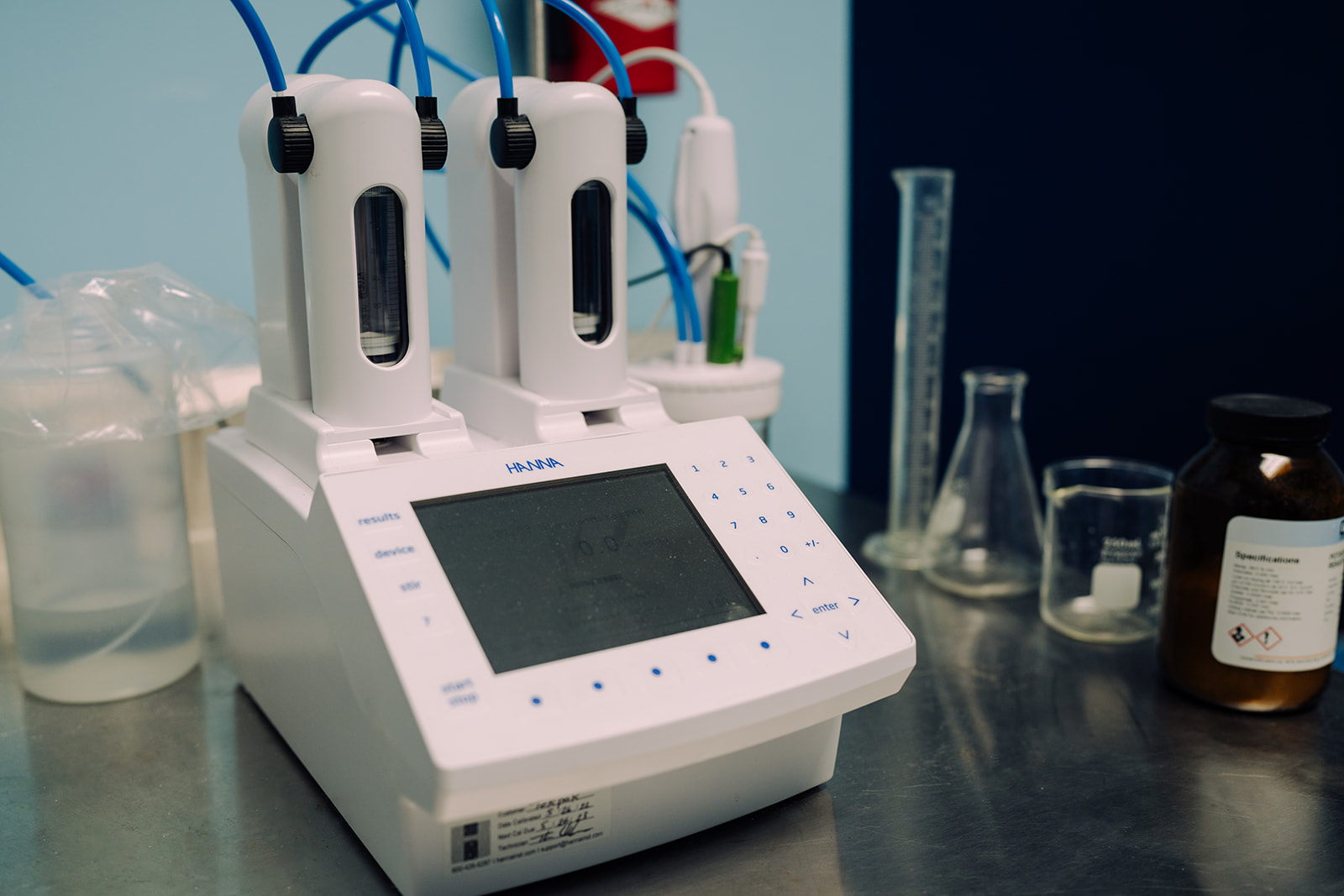
Blending QC analysis at TEKPAK's Marion, AL facility — when two ingredients with different particle behaviors are combined, distribution width becomes its own variable to control.
A supplier who can combine granulations to hit a custom target is offering operational problem-solving. That capability can help manufacturers minimize reformulation work, match legacy process behavior more closely, support sodium reduction initiatives, reduce segregation risk, and qualify replacement suppliers faster.
TEKPAK blends sea salt at its Bessemer, Alabama facility, most commonly for reduced sodium applications involving potassium chloride. The same capability supports particle size matching.
When two ingredients with different particle behaviors are blended together, distribution width becomes its own process variable.
Match the application
Successful supplier transitions depend on more than matching a nominal range on a spec sheet.
Particle distribution, anti-caking systems, lot-to-lot consistency, and supply stability all affect what happens when production scales up.
Before reaching out to a prospective supplier, define four things internally:
- The particle size window you actually need: range, distribution shape, and constraints at each bound.
- Non-negotiables: anti-caking requirements, additive restrictions, certifications, allergen statements, and documentation needs.
- Tolerance for variation: how tightly the supplier's typical values need to sit relative to specification maximums.
- Validation protocol: what passes at lab scale, line trial, and production qualification.
Send those four things to a prospective supplier and the conversation gets specific very quickly. You'll usually know within one exchange whether they can actually support your application.
Ready to match your spec, not just your price point? Share your particle size window, distribution constraints, and documentation requirements with TEKPAK. We supply three Dead Sea salt granulations and blend to custom targets — learn more about TEKPAK's sea salt supply or reach out directly.